Page Compiled By: Martin Melaugh
CAIN (Conflict Archive on the INternet - cain.ulster.ac.uk) is an Archive / Web site which provides a wide range of information and source material on the Northern Ireland conflict (from 1968 to 2007) and politics in the region. The Archive also contains some general information on Northern Ireland society. The CAIN Project began in 1996 and the Web site was first made available on-line in March 1997.
Update on CAIN
There is a brief update on the current (February 2021) situation of CAIN. It includes a note of the consultation that was held in 2019, and the discussions around the options for CAIN.
There are CAIN Flyers / Leaflets available with background information on various aspects of the work of CAIN.
Location
CAIN is located on the Magee Campus of
Ulster University (www.ulster.ac.uk).
Institutional Relationships
CAIN is based within INCORE (International Conflict Research Institute - www.incore.ulster.ac.uk), which is part of the School of Applied Social and Policy Sciences, within the Faculty of Arts, Humanities and Social Sciences, in Ulster University.

CAIN was an associate of ARK (Access Research Knowledge - www.ark.ac.uk) from 2000 to 2024. ARK is a resource involving staff from Ulster University and Queens University Belfast.

Background on the CAIN Project
CAIN-ConflictArchive on theINternet
CAIN is the acronym given to the Archive / Web site, and the Project which is developing the Archive.
Development of an Archive / Web site on 'the Troubles' and politics
The main 'product' of the CAIN Project is the CAIN Archive / Web site. CAIN staff were also part of the team which developed the Accounts of the Conflict (accounts.ulster.ac.uk) Archive / Web site
Target audience - Higher Education sector and beyond
The target audience was initially the Higher Education sector in the United Kingdom (UK). However the site is available free to anyone with Internet access and over half of users are from outside the UK.
Background information on the conflict
Those who are new to the subject of the Northern Ireland conflict will find a range of information and source material that will provide a useful introduction to the topic.
Guidance and information for researchers
It is also hoped that those who are carrying out academic research on the subject of 'the Troubles' will find the CAIN Archive a useful resource.
Funding
CAIN has been funded by a number of organisations:
2024: Department for Communities
2023: Department for Communities
2021: Reconciliation Fund, DFAT
2021: Department for Communities
2020 - 2021: Initiatives of Change Committee in Ireland
2020: Reconciliation Fund, DFAT
2019 - 2020: Reconciliation Fund, DFAT
2019 - 2020: ARK
2018: Reconciliation Fund, DFAT
2016 - 2017: Ulster University
2017: CRC
2016: Reconciliation Fund, DFAT
2013 - 2014: European Union's PEACE III programme
2013 + 2014: Reconciliation & Anti-Sectarianism Funds, DFAT
2010: AHRC
2006 - 2012: ESRC
2006 - 2008: AHRC
2002 - 2005: The Atlantic Philanthropies
2002: University of Ulster
1998: DENI & CCRU
1996 - 1997: eLib
For full details see the page on CAIN Funding.
Original Partners on CAIN Project
Original Partner Institutions:
The development of CAIN was initially undertaken (1996-1997) by threepartner institutions:
theUniversity of Ulster, (now Ulster University)
theQueen's University of Belfast, and
theLinen Hall Library.
Other groups and individuals:
A number of other groups and individuals have provided support to CAIN. For example, within Ulster University the following groups had an input into the Project:
ARK (2000-2024);
Centre for the Study of Conflict (1977-2000);
Educational Services; and
INCORE (International Conflict Research Institute) (1996-present).
Objectives
The CAIN Project has a number of objectives:
Establish and promote a resource of use to researchers, teachers, students and librarians
Encourage those who hold relevant information to contribute to the service
Collaborate with and link to other initiatives
Explore content, design and technical issues
Key Benefits
The main benefits of CAIN are:
Improve access to information and source materials
Assist in preparation of learning materials
Encourage active learning
Promote the awareness, value and use of networked information
Reduce pressure on library resources
Trends in the topic area
There is a growing interest in:
Conflict and peace studies
Political studies, and
Irish Studies
Further Information
More particular information on the early development of the CAIN Project (details of staff, list of papers, access statistics, promotional activities, etc.) can be found on the Project Background page.
Navigation / Finding Information
The following information on the layout and content of CAIN site is intended for first-time users or anyone who is having problems finding information.
Near the top of each web page on the CAIN site is a 'navigation' or 'status' bar which will help you to move between the main sections and also act as a reminder of your position in the site.
At the bottom of each page are a series of 'buttons' which provide links to: CAIN home page; information about CAIN; the site index; the site map; answers to frequently asked questions (FAQs); the search page; and contact details:
If you are unsure about the location of particular information you should consult the 'help' page which contains links to the main index page and a site map. If you are still having problems you should try the full-text search facilities, which allow you to search for particualar words or phrases across the whole site. As a last resort you could contact the CAIN Director.
Outline of the CAIN Internet Site
The remainder of this web page provides an outline of the CAIN Web site. You should use the 'BACK' button on your browser to return to this page.
Main Sections of the CAIN Web Site
Material contained in the above sections comes from 3 main sources:
material which was initially published in paper format; example
text written by members of the CAIN Team; example
text written specially for the CAIN Web site; example
Background Information
The 'Background Information' on the conflict contains a number of sections:
Introductions
Brief introductions to the Northern Ireland Conflict
Background on Northern Ireland society
Frequently Asked Questions (FAQs)
Guides
Guide to carrying out research on Northern Ireland
Guide to other Web sites containing information on the conflict and politics
List of acronyms
Glossary of terms related to the conflict and politics
Other Background Information
Bibliography of the conflict
Other bibliographies, databases, and electronic services
Chronology of main events
Abstracts on prominent organisations
Biographies of people prominent during 'the Troubles'
Database of those killed
Political initiatives
Policy initiatives
Political 'solutions'
Election results
Government Reports, and Acts of Parliament
The media and the conflict
Personal accounts of the conflict
The arts and the conflict:
Political Wall Murals in Northern Ireland
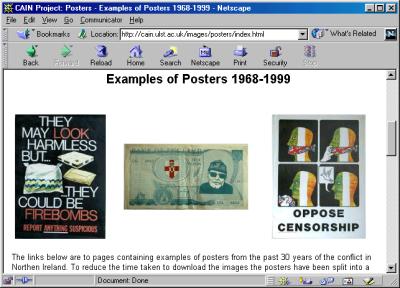
Examples of Political Posters, 1968-1999
Symbols used in Northern Ireland
Photographs
Key Events
The CAIN Archive provides information on major events:
Civil Rights Campaign (1964 to 1972);
Derry March (5 October 1968);
People's Democracy March (1 January 1969 to 4 January 1969);
Deployment of British Troops (14 August 1969 to 31 July 2007);
Internment (1971 to 1975);
'Bloody Sunday' (30 January 1972);
Introduction of Direct Rule (30 March 1972);
'Bloody Friday' (21 July 1972);
Sunningdale Agreement (6 December 1973 to 9 December 1973);
Ulster Workers' Council Strike (May 1974);
Dublin and Monaghan bombs (17 May 1974);
IRA Truce (9 February 1975 to 23 January 1976);
Constitutional Convention (8 May 1975 to 5 March 1976);
United Unionist Action Council (UUAC) Strike (3 May 1977 to 13 May 1977);
Hunger Strike (1981);
Northern Ireland Assembly (November 1982 - June 1986);
Anglo-Irish Agreement (15 November 1985);
Brooke / Mayhew Talks (April 1991 to November 1992);
Peace Process (1993 to the present);
Omagh Bomb (15 August 1998).
Key Issues
The CAIN Archive also provides information on a number of major issues:
Abstentionism by Republicans
Collusion between Security Forces and Paramilitaries
Commemoration related to the conflict
Community Relations in Northern Ireland
Cross-Community / Mixed Marriages in Northern Ireland - Report on Cross-Community Marriage in Northern Ireland (1992)
European Union
'The European Union and Relationships Within Ireland', J. Ingraham (1998)
Result of The 2016 Referendum on the European Union
Documents related to the Brexit issueLaw and Order / Administration of Justice
Restorative JusticeThe Media and the conflict
Minority Languages in Northern Ireland
Parades in Northern Ireland
Population demographics
Victims, Survivors
(See also earlier section: Victims of the Conflict)Women and the conflict
Use Made of the CAIN Web Site
Access Statistics- full details of visits / page views (1996-present)
During 2020 there were an average of 72,000 unique visitors per month who generated an average of 232,000 page views each month
one third of users are from Britain and Ireland; one third from the USA; and one third from Europe and the rest of the world
(The access statistics exclude 'non-viewed' traffic.)
CAIN contains information and source material on the conflict and politics in Northern Ireland.
CAIN is based within Ulster University.