Page Compiled By: Martin Melaugh
Summary
We truly need to remember those who have suffered, to grieve at the side of this communal grave, to reflect upon the truth of what occurred and to move forward from there. Above all, we have to persuade our children how costly and counter-productive it would be to pursue the animosities of the past.
The Bloomfield Report (1998; p23)
As with the Anglo-Irish Truce of 1921, different communities and organisations in Northern Ireland, Great Britain and the Republic of Ireland continued to erect (and to destroy) partisan monuments throughout the cease-fires of the 1990s. Recent attacks on new memorials in Counties Down and Fermanagh strengthen the argument that future commemorative projects should respect local sensitivities regarding design, inscription and the historic associations or contemporary demographic composition of the site chosen.
Jane Leonard (1997; p5)
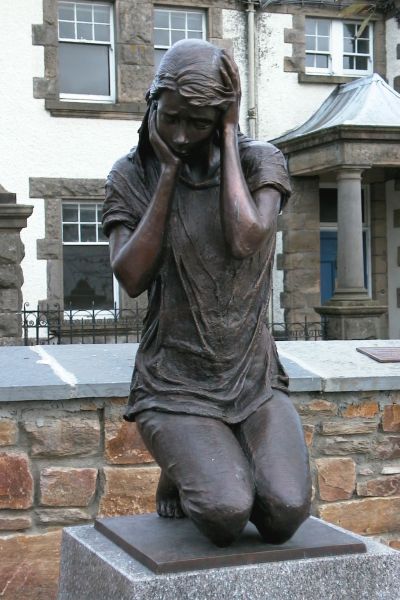
This section deals with aspects of commemoration in Northern Ireland. Specifically it looks at how the victims of the modern conflict ('the Troubles' 1969 to the present) are remembered and commemorated.
Commemoration takes many forms in Northern Ireland. At its most visible it can take the form of stone memorials in public places and their associated commemorative events. At the other end of the spectrum it might involve the private act of remembrance by a lone relative. In between there are dozens of ways in which the victims of the conflict are remembered. These include: church services, 'rolls of honour', books of remembrance, gardens of remembrance, stain-glass windows, parades by various official institutions, non-official paramilitary parades, portrait banners commissioned by parading organisations, murals, names inscribed on stone or metal plaques, metal crosses, stone memorials in various forms, statues, etc.
Currently there is no single event or memorial to commemorate all the victims of the conflict and there remains a debate as to whether this should, or can, be done. Acts of commemoration and memorials can prove to be controversial with one section, or other, of the community objecting to the form or manner of the commemorative event. Physical monuments have in the past been attacked and destroyed.
Following the first paramilitary ceasefires in 1994 the question of what should be done for the bereaved and the injured of the conflict, as well as a possible memorial scheme for the dead, became a more pressing issue for the British government. The government's response was to establish the Victims Commission (the appointment of the first Commissioner, Kenneth Bloomfield, was announced on 24 October 1997) and to request a report on the issues. This report was published in April 1998 and the Victims Liaison Unit was established on 30 June 1998 to implement the recommendations of the report.
selected reading list
background information
Walker, Brian. (2001) 'Remembering the siege of Derry: the rise of a popular religious and political tradition, 1689-1989' from the book: Kelly, William. (ed.) The Sieges of Derry
chronology
Hamber, Brandon. (2001) 'Chronology of "Victim" Related Issues in Northern Ireland' {external_link}
main pages
Bloomfield, Kenneth. (1998) 'We Will Remember Them': Report of the Northern Ireland Victims Commissioner Sir Kenneth Bloomfield KCB (April 1998). Belfast: The Stationery Office Northern Ireland.
Leonard, Jane. (1997) 'Memorials to the Casualties of Conflict: Northern Ireland 1969 to 1997'. Belfast: Northern Ireland Community Relations Council.
Hamber, Brandon., Kulle, Dorte., and Wilson, Robin. (2001) Report 13 - Future Policies for the Past (February 2001). Belfast: Democratic Dialogue.
Sutton, Malcolm. (1994) Bear in mind these dead ... An Index of Deaths from the Conflict in Ireland 1969-1993. Belfast: Beyond the Pale.
[See also the revised and updated Sutton Index of Deaths 1969-2001.]
list of source material
Users should also refer to the following related sections:
CAIN contains information and source material on the conflict and politics in Northern Ireland.
CAIN is based within Ulster University.