Page Compiled By: Fionnuala McKenna
Contents:
What is a Policing Plan?
Why do we need one?
What will it mean to me?
What consultation took place
What was the outcome?
What is meant by policing objectives?
How will I know if the police really do what is in this Plan?
What can I do to help?
Table 1: Objectives and Performance Monitoring established
by the Secretary of State for 1998/99Table 2: Local Objectives and Performance Monitoring established
by the Police Authority for 1998/99Allocation of Resources
Reporting Back and Review
Royal Ulster Constabulary
Aim
Purpose
Values
Standards and Behaviour
Mission Statement
What is a Policing Plan?
Issued by the Police Authority, a Policing Plan is a clear public statement of yearly objectives and measurable targets for the delivery of a quality police service within Northern Ireland. It also forms part of the overall strategic planning process used by the police service.
Prepared by the Chief Constable, this Plan is agreed by the Police Authority, based on its consultation with the local community about their policing needs and is endorsed by the Secretary of State.
The plan gives the public information about the overall level of police resources and how they will be used throughout the year.
A key aim of a Policing Plan is to provide a real and meaningful opportunity for people to influence the way their police service is delivered.
Why do we need one?
Annual Policing Plans have been operating in England and Wales for three years and are proving successful in giving communities a say in the running of their police service.
They are now being introduced in Northern Ireland, ahead of legislation, because the Police, the Police Authority and the Government believe the local community must have a direct input into how the police service is developed, delivered and monitored. The policing of Northern Ireland requires this partnership between the police and the community they serve.
The Authority's role is to establish and secure the maintenance of an effective and efficient police force, while the Chief Constable's job is to direct and control its operations. As well as being a key element in setting the style of policing, the new Policing Plan further increases the accountability of both these organisations to the community they serve.
What will it mean to me?
You have the right to expect the highest possible standards from your police service. The Policing Plan provides a realistic undertaking by the police to meet public expectations within available resources and sets out clear performance indicators to allow you to assess its effectiveness.
The Police are committed to providing a quality service. That is why all police activity is subject to a clear Statement of Purpose and Values contained in the Royal Ulster Constabulary's Charter.
What consultation took place?
The Police Authority consulted directly with the community to find out what people wanted and to identify their policing priorities. Before agreeing this Policing Plan the Authority carried out public opinion surveys, research with the Community & Police Liaison Committees and discussion with a wide range of people and organisations throughout Northern Ireland.
What was the outcome?
As a result of these widespread consultations, the Authority has concluded that the following policing priorities need to be addressed: reducing crime; building confidence in the Police; tackling behaviour which is threatening, intimidating and anti-social; improving the service delivery of the Police by reassuring the public through visible police patrols and ensuring a prompt response to emergency calls; improving organisational effectiveness.
What is meant by policing objectives?
Introduced this year by the Police Authority, prepared by the Chief Constable and endorsed by the Secretary of State, this Policing Plan contains objectives which are a set of measurable policing aims. Set by the Police Authority and the Secretary of State, and agreed with the Chief Constable, these objectives reflect community needs and concerns.
Reviewed annually, policing objectives are intended to represent a long term approach to policing and will give the community a real opportunity to ensure that its police deliver the type of service it needs.
In addition, area Police Commanders will consult and identify specific issues on which they will focus and work with local people. These local priorities are available to the public and enable a working partnership on the ground between police officers and individual communities.
How will I know if the police really do what is in this Plan?
The Police Authority will monitor the performance of the Police against the objectives and measures stipulated in the Plan. Targets have been set by taking into account previous achievements and local policing conditions and the results will be analysed and made public. In this way you will be given a clear assessment of how well the Police achieve their objectives and provide value for money each year.
The emphasis and importance given to each objective must reflect the needs and demands of the whole community. The Plan must be sufficiently flexible to cope with any exceptional pressures.
What can I do to help?
The police service does not operate in isolation from the community - it is an integral part of it. In order to be truly effective, it needs the co-operation of the community, local government, voluntary agencies, local organisations, businesses, etc. A safer society depends upon the community and the police working together for the good of all, particularly those most vulnerable. You have a key role to play in ensuring your opinions on local policing are taken into account and this can be achieved by contributing views to your local Community and Police Liaison Committee.
Table 1: Objectives and Performance Monitoring
established by the Secretary of State for 1998/99
OBJECTIVE | PERFORMANCE INDICATORS | PERFORMANCE MONITORING |
To counter anyte rrorist threat on behalf of the community and ta bring to justice those responsible for terrorist crime. | Information will be provided on the following areas:- | Trends will be monitored and be reported in these areas. |
To maintain public order, thereby providing forthe protection and security of the public. | Information will be provided in the following areas: | Total number of parades (legal and illegal) Number of: |
To reduce violent crime in Northern Ireland and increase the proportion of violent crimes detected. | The number of violent crimes. Information will also be provided in the following areas: | To reduce the number of violent crimes. Clear at least 55% of violent crimes. |
To reduce burglaries in Northern ireland and increase the proportion of domestic burglaries detected. | Number of burglaries. | Reduce the number of burglaries. |
To reduce the number of those killed and seriously injured in road traffic accidents. | Number of fatal and serious casualties. | Reduction in fatal and serious casualties by 2%. |
Number of accidents (fatal and serious injury) | Reduce the number of accidents (fatal and serious | |
To target the illegal supply of controlled drags and to work in portnership with other agencies in tackling the problem of drag misuse. | The number of arrests and disposals, including possession and supply of drugs. | Trends will be monitored and reported in these areas. |
Table 2 Local Objectives and Performance Monitoring
established by the Police Authority for Northern Ireland 1998/99
OBJECTIVE | PERFORMANCE INDICATORS | PERFORMANCE MONITORING |
To reduce overall crime. | The number of reported crimes. Overall detection rate. | Reduce the number of crimes. Clear at least 32% of all crimes. |
To raise public confidence in the Royal Ulster Constabulary. | Public satisfaction levels with the ability to: | Increase public satisfaction levels in these areas and provide information on the proportion of women and Catholic officers and the number of officers given training in Community Awareness. |
To target and prevent crimes and tackle behaviour which is threatening, intimidating and anti-social in partnership with local communities and agencies. | The number of property crimes. | Reduce by: |
To improve the service delivery of the police to all sections of the community. | Public Attitudes Surveys. | Monitor trends and maintain a 71% satisfaction level. |
To improve organisational effectiveness. | The level of absence owing to sickness among police and civilian staff. | Reduce the level of absence owing to sickness to 13 days among police and 18 days among civilian staff. |
Allocation of Resources
The Secretary of State has established a grant for policing in the financial year 1998/99 at £657.55 million. While this represents a decrease in real terms on the previous year's grant, it will be kept under constant review.
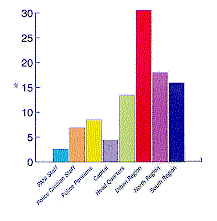
The following table and bar chart indicates the proposed breakdown of this budget into the major expenditure areas.
Breakdown of Revenue Expenditure for the
Royal Ulster Constabulary 1998/99
Total Costs £000 | ||
Police Expenditure | 509,150 | |
Civil Support Staff | ||
Police | 45,700 | |
Transport & Communication | 31,950 | |
Accommodation Services | 36,050 | |
Gross Expenditure | 664,450 | |
Net Expenditure | 657,550 | |
Where the 1998/99 Gross Budget will be spent
(£657,550,000)
Reporting Back and Review
This planning process is a continuous one and will enhance accountability through the measurement of police activity. Performance within targets set by this plan will be monitored and forwarded to the Police Authority every three months. The Authority will carry out an in-depth assessment of progress placing the results in context in terms of the policing circumstances prevailing during that time in Northern Ireland. At the end of the financial year, a full report will be produced setting out the achievements of the Royal Ulster Constabulary against the objectives and targets established in this plan.
This policing plan requires the support and co-operation of the whole community Through working together we can improve quality of life for all and make Northern Ireland a safer place in which to live. Partnership is the foundation for all aspects of policing in this country It will continue to be central in the relationship between the Royal Ulster Constabulary and the Police Authority for Northern Ireland to ensure the provision of an effective police service far all the people of Northern Ireland.
Mr Pat Armstrong CBE | Mr Ronnie Flanagan OBE MA |
ROYAL ULSTER CONSTABULARY
OUR AIM
To provide a high quality, effective police service to all the people of Northern Ireland. We will work to achieve this in partnership with the community and in co-operation with other agencies.
OUR PURPOSE
To uphold the rule of law
To bring to justice those who break the law.
To play our full part in the eradication of terrorism and the prevention of crime
To help preserve the peace
To protect, reassure and assist those whom we serve.
OUR VALUES
Honesty
Impartiality
Courtesy
Compassion
Courage
OUR STANDARDS AND BEHAVIOUR
We will perform our duty with integrity, common sense and sound judgement and be sensitive to the views of the community in our actions.
We will offer assistance to members of the public irrespective of their age, sex, their political or religious beliefs or their ethnic or social background.
We will manage our organisation in the most professional manner, seeking the opinions of our staff, promoting equal opportunity for all and showing a willingness to change where such change is necessary.
We will adhere to our code of professional policing ethics.
MISSION STATEMENT
The Police Authority for Northern Ireland aims to secure for the Northern Ireland Community the provision of an impartial, acceptable, effective and efficient police service which is accountable to that community through the Authority.
CAIN contains information and source material on the conflict and politics in Northern Ireland.
CAIN is based within Ulster University.